Hiring the right employees is one of the most important decisions a business can make. The people you bring into your organization influence productivity, customer experience, company culture, and long-term growth.
However, finding qualified candidates is not always straightforward. Some businesses manage the entire hiring process internally, while others work with recruitment agencies to identify and attract suitable talent.
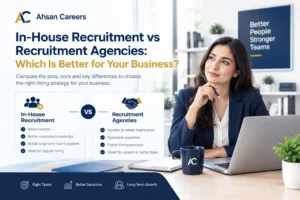
So, when comparing in-house recruitment vs recruitment agencies, which option is better for your business?
The answer depends on your hiring volume, internal resources, budget, industry, and the type of professionals you need to recruit.
In this guide, we will explain how both approaches work, compare their advantages and limitations, and help you choose a recruitment strategy that supports your business goals.
What Is In-House Recruitment?
In-house recruitment is a hiring approach in which a company’s internal team manages recruitment activities.
This responsibility may belong to an HR department, an internal recruiter, a talent acquisition specialist, or a manager who handles hiring alongside other duties.
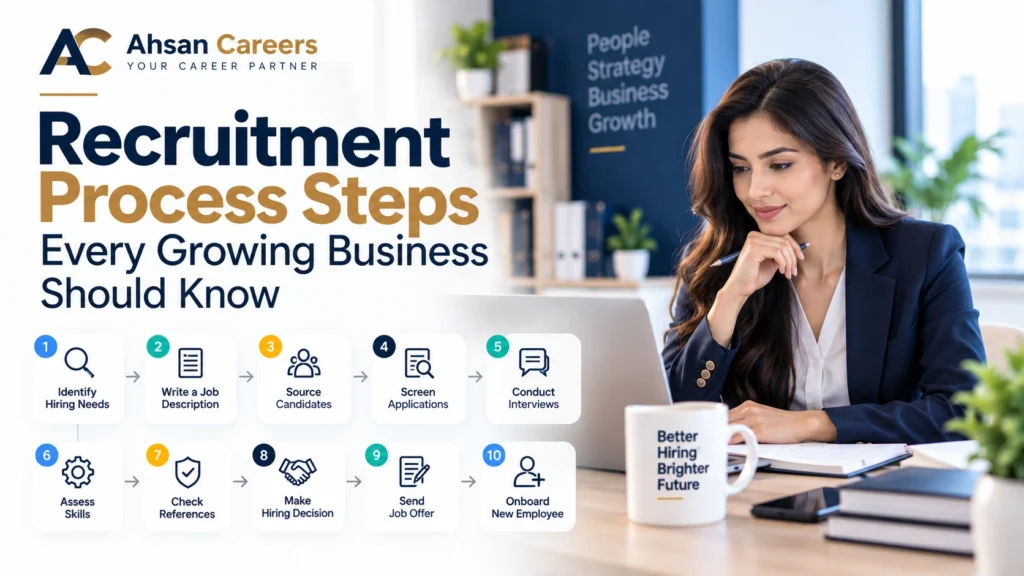
An in-house recruitment team may be responsible for:
- Identifying staffing requirements.
- Writing job descriptions.
- Advertising vacancies.
- Reviewing applications and resumes.
- Conducting initial interviews.
- Coordinating assessments and interviews.
- Communicating with candidates.
- Supporting job offers and onboarding.
Because internal recruiters work within the organization, they can develop a deeper understanding of its culture, business objectives, and team requirements.
This approach can work particularly well for companies with consistent hiring needs and the internal resources to manage recruitment effectively.
What Are Recruitment Agencies?
Recruitment agencies are external service providers that help businesses find and hire suitable candidates.
Depending on the agreement, an agency may manage some or most stages of the recruitment process. Some specialize in particular industries, job functions, seniority levels, or employment markets.
Recruitment agencies may provide services such as:
- Candidate sourcing and outreach.
- Resume screening and shortlisting.
- Initial candidate interviews.
- Specialist or executive talent searches.
- Interview coordination.
- Recruitment market insights.
- Support with time-sensitive vacancies.
Businesses typically pay for these services according to an agreed fee structure. The cost and payment terms vary by agency, role, and recruitment arrangement.
Recruitment agencies can be particularly useful when an organization lacks internal recruitment capacity, needs specialist expertise, or is hiring for a difficult-to-fill position.
In-House Recruitment vs Recruitment Agencies: Key Differences
Although both approaches aim to help businesses hire the right people, their operating models differ.
1. Cost and Budget
In-house recruitment
Internal hiring involves costs such as recruiter salaries, recruitment software, job advertising, training, and other operating expenses.
For companies with frequent recruitment requirements, an established internal team may provide value over time. However, the full cost of maintaining that team should be considered.
Recruitment agencies
Agencies charge according to their service model. Some use a placement fee, while others may offer retained search or contract recruitment arrangements.
An agency may require less internal recruitment infrastructure, but its fees can be significant, particularly for senior or specialized positions.
Which is better?
An in-house team may be suitable for businesses with recurring hiring needs and sufficient internal resources. An agency may be more practical for occasional, urgent, or specialist recruitment.
Compare the total expected cost rather than looking only at a recruiter’s salary or an agency’s fee.
2. Speed of Hiring
In-house recruitment
Internal teams understand the company’s approval processes and can coordinate directly with hiring managers. This familiarity can help move recruitment forward efficiently.
However, a small team managing several vacancies may struggle to maintain momentum.
Recruitment agencies
Agencies may have established sourcing processes, candidate networks, and experience filling similar roles. These resources can help them identify potential candidates more quickly.
Nevertheless, results depend on the role, market conditions, candidate availability, and how quickly the employer makes decisions.
Which is better?
An agency may offer an advantage when a vacancy is urgent or difficult to fill. An experienced internal team may be more efficient when the organization has a predictable hiring process and steady recruitment demand.
3. Access to Qualified Candidates
In-house recruitment
Internal recruiters can build a talent pipeline through referrals, careers pages, professional networks, job boards, and previous applicants.
Over time, this can create a valuable pool of candidates familiar with the organization.
Recruitment agencies
Agencies may have access to professional networks, specialist candidate databases, and passive candidates who are not actively applying for jobs.
The quality of this access varies, so businesses should evaluate an agency’s relevant experience rather than assuming every agency has the right talent.
Which is better?
Both approaches can attract excellent candidates. The deciding factor is often the strength of the sourcing strategy and how effectively candidates are assessed against the role’s requirements.
4. Industry Knowledge and Specialist Expertise
In-house recruitment
An internal team can develop detailed knowledge of the company’s products, working environment, team structure, and long-term objectives.
However, it may have limited experience recruiting for an unfamiliar role or a highly specialized field.
Recruitment agencies
An agency specializing in a particular industry may understand relevant skills, market expectations, and candidate availability.
This can be helpful when recruiting senior leaders, technical professionals, or candidates with uncommon expertise.
Which is better?
In-house recruitment may be sufficient for familiar roles. Specialist agencies can be valuable when a position requires expertise that the internal team does not have.
5. Control Over the Hiring Process
In-house recruitment
Internal teams retain direct oversight of recruitment activities, communication, candidate experience, and decision-making.
They can also adapt the process to internal policies and company culture.
Recruitment agencies
Working with an agency introduces an external partner into the process. The employer should agree on responsibilities, communication standards, selection criteria, and reporting expectations.
The business should retain control over the final hiring decision.
Which is better?
In-house recruitment offers direct operational control. Agency recruitment can still provide strong oversight when expectations and responsibilities are clearly defined.
6. Candidate Experience and Employer Branding
In-house recruitment
Internal recruiters can explain the company’s culture, values, benefits, and career opportunities from direct experience.
They can also help maintain consistent communication across the candidate journey.
Recruitment agencies
Agencies act as representatives of the employer during parts of the recruitment process. Their communication style and professionalism can influence how candidates perceive the business.
Clear instructions and regular feedback help ensure that the agency represents the employer accurately.
Which is better?
Either model can deliver a positive candidate experience. Consistent communication, realistic job information, timely feedback, and respectful treatment are essential regardless of who manages recruitment.
Advantages and Disadvantages at a Glance
| Factor | In-house recruitment | Recruitment agencies |
|---|---|---|
| Cost structure | Internal operating costs | External service fees |
| Internal knowledge | Strong company familiarity | Depends on the agency’s briefing and experience |
| Candidate sourcing | Internal channels and talent pools | Agency networks and sourcing resources |
| Specialist hiring | Depends on team expertise | Can offer specialist knowledge |
| Process control | Direct internal management | Shared responsibilities |
| Best suited for | Consistent, recurring hiring | Specialist, urgent, or additional hiring support |
Neither option is automatically better for every organization. The right choice depends on what your business needs and what resources it already has.
When Should a Business Choose In-House Recruitment?
In-house recruitment may be the better option when:
- Your business hires regularly throughout the year.
- You already have an experienced HR or talent acquisition team.
- You want to build long-term talent pipelines.
- Your hiring requirements are relatively predictable.
- You need close coordination between recruiters and hiring managers.
- You want recruitment activities closely aligned with internal policies and culture.
For example, a growing organization hiring across several departments every month may benefit from having a dedicated internal recruiter who understands its workforce needs.
However, an internal team still needs the right tools, processes, and capacity to deliver consistent results.
When Should a Business Use a Recruitment Agency?
Recruitment agencies may be a better fit when:
- You need to fill a vacancy quickly.
- Your internal team has limited capacity.
- The position requires specialized industry knowledge.
- You are recruiting for senior or executive-level roles.
- Your organization needs access to a broader candidate pool.
- You are hiring for a role that rarely becomes available.
- You need temporary recruitment support during a busy period.
For example, a company looking for a specialist technology leader may benefit from working with a recruiter who understands the relevant talent market.
Before choosing an agency, clarify its experience, fee structure, candidate screening process, communication expectations, and any replacement or guarantee terms.
Is a Hybrid Recruitment Model Better?
Many businesses do not need to choose exclusively between internal recruitment and external agencies.
A hybrid approach combines an internal hiring function with external support when necessary.
For example, a company might use its HR team for regular vacancies while engaging an agency for executive searches, specialist technical positions, or periods of unusually high recruitment demand.
A hybrid model can provide flexibility without requiring the organization to maintain every recruitment capability internally.
To make it work effectively:
- Define which roles the internal team will manage.
- Establish when external support is appropriate.
- Agree on candidate ownership and communication processes.
- Set clear expectations for candidate quality and reporting.
- Measure results consistently across recruitment channels.
This approach allows businesses to use external expertise where it adds value while retaining internal knowledge and oversight.
How to Choose the Right Recruitment Strategy
Before deciding between in-house recruitment and recruitment agencies, assess your business against five practical questions.
1. How frequently do you hire?
Regular hiring may justify an internal team. Occasional recruitment may be easier to manage with external support.
2. How difficult are your vacancies to fill?
Roles requiring rare skills or extensive industry experience may benefit from specialist sourcing.
3. What resources are available internally?
Consider recruiter capacity, hiring manager availability, recruitment technology, and the time required to screen candidates.
4. What is your recruitment budget?
Compare the total cost of internal recruitment with the expected cost of external services. Include the time spent by hiring managers and the potential cost of an unfilled position.
5. How will you measure success?
Track metrics such as time-to-fill, cost-per-hire, candidate experience, offer acceptance, and new-hire retention where reliable data is available.
The goal is not simply to hire quickly or spend less. It is to find qualified people through a process that supports business performance and sustainable hiring decisions.
Common Recruitment Mistakes Businesses Should Avoid
Regardless of the approach you choose, several mistakes can reduce recruitment effectiveness.
- Choosing based on cost alone: The cheapest option may not deliver the skills or service your business needs.
- Using unclear job descriptions: Vague requirements can attract unsuitable applications and slow screening.
- Delaying interview decisions: Long gaps between stages can cause qualified candidates to lose interest.
- Failing to define responsibilities: Internal teams and agencies need clarity about who handles each stage.
- Ignoring candidate communication: Candidates should receive clear information and timely updates.
- Measuring only hiring speed: A quick hire is not necessarily a successful hire. Consider quality, retention, and role suitability too.
A well-defined recruitment process helps businesses make better decisions, regardless of whether they recruit internally or work with an external partner.
Frequently Asked Questions
Is in-house recruitment cheaper than using a recruitment agency?
It depends on hiring volume, internal staffing costs, agency fees, and the complexity of the roles. In-house recruitment may be cost-effective for recurring vacancies, while an agency may provide better value for occasional or specialist hiring needs.
Do recruitment agencies guarantee successful hires?
Not necessarily. Some agencies offer specific guarantees or replacement terms, but these depend on the contract. Review the agreement carefully and clarify what happens if a placement does not work out.
Can small businesses benefit from recruitment agencies?
Yes. A small business may benefit from external recruitment support if it lacks a dedicated HR team, needs specialist candidates, or cannot devote sufficient time to sourcing and screening applicants.
Can a company use both in-house recruiters and recruitment agencies?
Yes. A hybrid model allows an organization to manage routine vacancies internally and use external recruiters for specialist, senior, urgent, or high-volume hiring needs.
What should a business check before hiring a recruitment agency?
Review the agency’s relevant experience, recruitment process, candidate sourcing methods, fee structure, communication standards, references where available, and contractual terms.
Final Thoughts
Choosing between in-house recruitment and recruitment agencies is not simply a decision about cost. It is about matching your recruitment strategy to your organization’s hiring requirements, resources, and long-term objectives.
An internal team can offer company knowledge, direct control, and continuity. A recruitment agency can provide additional capacity, specialist expertise, and access to potential candidates. A hybrid approach may offer the most flexibility for businesses with varied hiring needs.
Start by assessing your current recruitment challenges, identifying the roles you need to fill, and comparing the realistic costs and benefits of each option.
The right recruitment strategy should help your organization attract qualified candidates, make informed hiring decisions, and build a stronger team.
Need Support With Your Recruitment Strategy?
Ahsan Careers helps businesses explore recruitment-related solutions and supports professionals navigating their career opportunities.
Visit Ahsan Careers to learn more about the services available and find an approach that aligns with your hiring or career goals.